
Stretching in Bali: how to choose between stretching, Pilates and yoga classes, what to check in a coach, and how to train in the heat and rainy season.
23 November 2026
Looking for stretching in Bali? You'll find a yoga shala on every second street, a reformer studio next to every smoothie bar, and a lot of classes that look the same on Instagram. Here's how to pick the one that actually moves your body forward, whether you're here for two weeks or two years.
On the island, these three get mixed up all the time. They overlap, but they train different things.
So start with one honest question: what do you want to change? If it's "I want to touch my toes without bending my knees" or "I want my splits", a stretching class is the most direct route. If it's "I slouch at my laptop and my core feels weak", Pilates in Bali is easy to find and a strong pick. If your back actually hurts, see a doctor first and then tell the coach about it. If it's "I want to slow down and feel calm", yoga does that well.
Not sure what a stretching class looks like from the inside? Here's a plain explanation of what a stretching class is and whether it's worth it.
Bali is beautiful, and that's part of the trap. A class can have a jungle view, a bamboo roof and a great playlist and still teach you nothing. Look at these things instead.
Start with the coach. Ask who's teaching and how they trained. A 200-hour yoga certificate is not the same as years of rhythmic gymnastics or ballet. For flexibility work, you want someone who knows how a joint moves and when to stop pushing.
Then look for a system. In a good stretching class, today's session builds on last week's. You warm up, work on strength, stretch deeper, and finish with control. If every class is a new improvisation, your progress will be random too.
Ask how they track progress. Can the coach tell you where you started? A good studio measures your range in centimetres and writes it down.
Check the group size. If there are twenty-five mats in a room and one teacher, nobody is correcting your pelvis in a split. Smaller groups mean someone actually sees you.
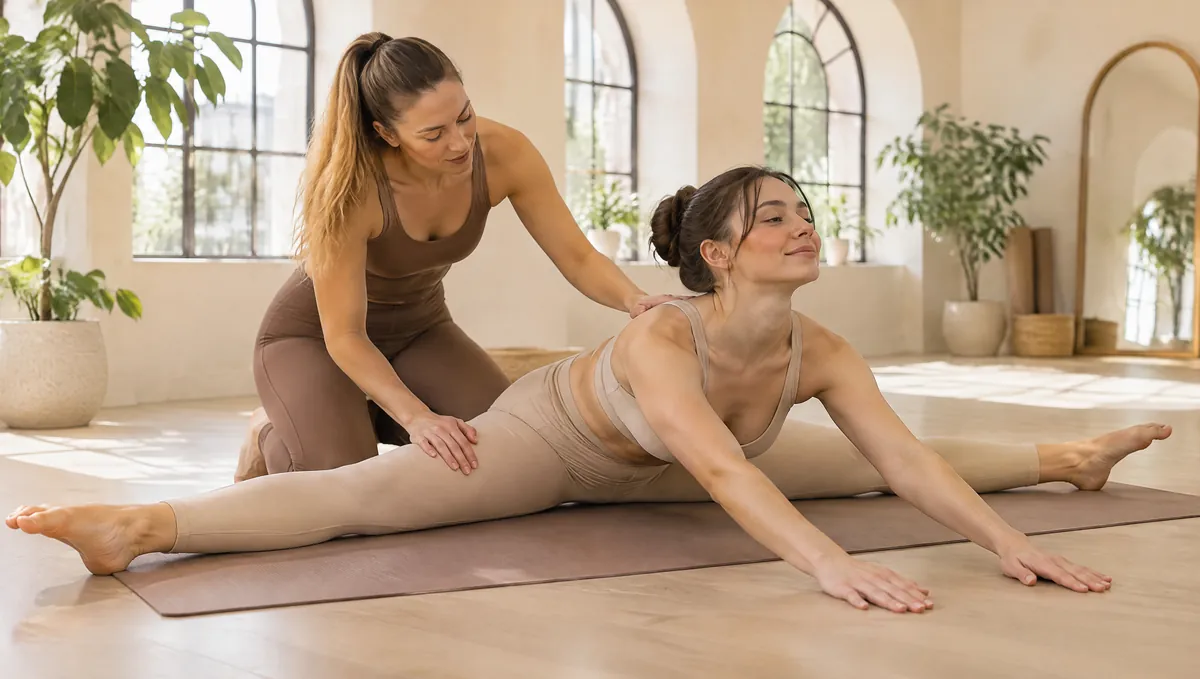
Watch how corrections happen. A coach should ask before touching, explain what they're adjusting and never shove you deeper. Pain is not a sign it's working.
We wrote a longer checklist on how to choose a stretching studio and what "premium" should really mean. It works in Bali the same way it works anywhere.
Training on the island has its own quirks. Plan for them and you'll stick with it longer.
A two-week holiday won't give you the splits. But it can give you a very good start and a plan to take home.
If you're here for 1-3 weeks:
If you live here or stay a few months:
A lot of people in Bali surf, ride or sit at a laptop for hours. All three tighten your hips and shoulders. If you surf, a stretching class works like maintenance for your hips and shoulders between sessions in the water.
The first month is mostly about learning to relax into a stretch instead of fighting it. That's when a coach matters most. More on that in our piece on stretching with a coach.
Save this and use it for any studio on the island:
If a studio answers most of these clearly, you're in good hands. If the answers are vague, keep looking.
TOPSTRETCHING® is an international brand of stretching and mobility studios for women, working since 2014. One of our studios is in Bali. The idea behind it is simple: more than splits. The splits are nice, but what we really care about is how your body feels, how you stand, and how confident you are in it.
The TOPSTRETCHING method grew out of rhythmic gymnastics, ballet and Pilates. It's a step-by-step system from zero to splits that mixes stretching, strength, posture and breathing, with progress measured in numbers. Many of our coaches are masters of sport or candidates for master of sport in rhythmic gymnastics, and every coach in the network trains to one standard. So a class in Bali follows the same logic as a class in Zurich.
There are 20+ directions in the method, from Split School and Body Ballet to Pilates and AEROSTRETCHING®, stretching in a hammock. Which ones run in a given week depends on the studio schedule.
Our studios page links to the Bali studio, where you'll find the schedule and how to book. Tell the coach what you want to change, and see how your body feels by the end of your first class. If you want to understand the thinking behind the method first, read More Than Splits.
Yes. A good stretching class starts with your current range, even if you can't touch your toes. Tell the coach you're new so they can give you easier options from the first warm-up.
A stretching class works on range of motion: splits, backbends, forward folds. Pilates works on core strength, control and posture. Many people do both: Pilates for a stable spine, stretching for flexibility.
Three to four times a week works well for a short trip. If you live on the island, two to three classes a week plus ten minutes on your own on other days is enough to see steady progress.
Probably not, and that's fine. Two weeks is enough to learn the right technique, feel a clear difference and take a home plan with you. Full splits usually take months of regular work.
Yes, if you drink enough water and don't skip the warm-up. Heat makes muscles feel looser than they are, so go slowly and stop at a strong but comfortable stretch, never at pain.
TOPSTRETCHING® has a studio in Bali. Start from our studios page: it links to the studio's own site with the address, schedule and booking.
Studios in Bali and Zurich: one method, coaches from professional sport and a trial class.
Find a studio →