
How to choose a stretching studio: what to check in coaches, method, group size, safety and community, plus a trial-class checklist to find your place.
24 October 2026
Choosing a stretching studio looks simple: search "stretching class near me", pick the closest dot on the map, book. But the studio you choose decides whether stretching becomes a habit that changes how you move, or a few awkward classes you quietly stop attending. This guide walks you through what actually separates a good stretching studio from an average one, and what the word "premium" should mean when you see it on a studio's website.
A stretching studio is a space built around flexibility, mobility and controlled strength, where a coach guides a small group through a structured class. That definition already hints at the criteria: who coaches, how the class is built, how many people are in the room, how safe it feels and what kind of community forms around it.
Many places call themselves a premium fitness studio. Often that means good lighting, a nice reception desk and branded towels. Those things are pleasant, but they do not move your splits a single centimetre.
In stretching, premium is about the quality of guidance and the logic behind every class. A truly premium stretching studio gives you:
At TOPSTRETCHING® we describe this as "More than splits": the splits are a milestone, but the real result is in your body, posture, state of mind and confidence. If you want the full philosophy, read More Than Splits: the TOPSTRETCHING® method.
The coach is the single biggest factor in your result and your safety. Stretching looks gentle, but working near the end of your range of motion demands expertise. A good coach knows when to push and, more importantly, when to stop.
What to look for:
A typical situation from coaching practice: a beginner folds forward, knees locked, and proudly reaches the floor by rounding her whole back. An average coach says "great". A good coach bends her knees slightly, lengthens her spine and shows that the real stretch starts in the back of the thigh, not in the lower back. That small correction is the difference between progress and a sore back.
Many TOPSTRETCHING coaches come from professional sport: masters and candidates for master of sport in rhythmic gymnastics, champions and certified specialists. Every coach in the network trains in one standard of the method, which is exactly why a class feels coherent no matter who leads it.
Random stretching gives random results. A good studio can explain how a beginner gets from "can't touch my toes" to a confident split, step by step.
Call or message the studio and ask. Here is what a weak answer and a strong answer sound like.
"I am a complete beginner. Which class should I join?"
Weak: "Any class, just come."
Strong: "Start with a beginner or open-level class. The coach will ask about your experience and injuries and give you easier options."
"How will I know I am making progress?"
Weak: "You will feel it."
Strong: "We measure your range at the start and check it again over time, so you see the change in numbers."
"Do you only stretch, or is there strength work too?"
Weak: "We just stretch, it is relaxing."
Strong: "Every class combines stretching with strength, posture and breathing. Passive stretching without strength leaves joints unprotected."
Also ask whether there are formats for different goals, such as splits, back health, aerial work, or classes during and after pregnancy.
The TOPSTRETCHING method grew out of rhythmic gymnastics, ballet and Pilates. It is a step-by-step system from zero to the splits: progression, a complex approach (stretching plus strength plus posture plus breathing), and progress measured in numbers rather than "by eye". If the splits are your goal, our safe beginner's guide to the splits shows what that progression looks like in practice.
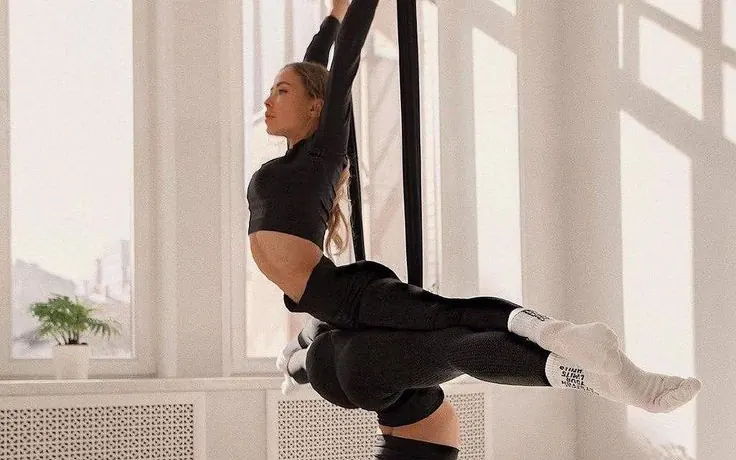
Variety matters too. A studio with several directions lets you grow without leaving: AEROSTRETCHING® in the hammock, Body Ballet, Barre, Pilates, Split School and more. Curious about the hammock? Read about AEROSTRETCHING®.
Even the best coach cannot correct twenty people at once. Small groups are one of the clearest signs of quality in stretching classes, because individual attention is what prevents both stagnation and injury.
Safety checklist for any stretching class:
One honest note: if you have pain, an injury, are pregnant or have recently given birth, talk to your doctor first and choose a class designed for your situation. Our articles on choosing a class for a healthy back and stretching after childbirth go deeper into these cases.
Results in stretching come from regularity, and regularity comes from wanting to be there. That is why atmosphere is not a luxury; it is part of the method.
Notice how the studio feels:
A studio is an environment where you get better and meet people who are doing the same. We wrote a whole piece about this idea: the studio as an environment. When you find that kind of place, consistency stops being a matter of willpower.
The trial class is your best research tool. Go in with a plan and you will know within one session whether the studio fits.
Before the class:
During the class:
After the class:
If most answers are yes, you have found your stretching studio. If not, try another one; it is worth the search.
TOPSTRETCHING® is an international brand of stretching and mobility studios for women, working since 2014. Today our studios are in Bali and Zurich, and a new studio in Phuket is under construction. Each one follows the same method and the same coaching standard, so the experience stays consistent wherever you train.
Here is how our studios answer the checklist above. Many of our coaches are masters and candidates for master of sport in rhythmic gymnastics, and every coach trains in one standard of the method. Classes follow a step-by-step progression, and your range is tracked in numbers, not by eye. With 20+ directions, from AEROSTRETCHING® and Split School to Barre, Pilates and TOP MAMA, you can keep growing in one place. More about the method is on the brand page.
Each studio has its own website: topstretching.id for Bali and topstretching.ch for Zurich. If there is no studio in your city yet, you can start with the online club and marathons. Ready to test a studio with the checklist? Find your studio and its schedule via the studios page and book a trial class.
Look at the coaches' background, whether classes follow a clear progression, how small the groups are and how the studio handles safety. Then book a trial class and check whether you got personal attention and wanted to come back.
Premium in stretching means expert coaches, a structured method, small groups and measurable progress, not just a beautiful interior. The design is a bonus; the guidance is the product.
Expect a warm-up, a guided main part with stretching and strength elements, and a calm finish. A good coach will ask about injuries and offer easier options where needed.
For most beginners, two or three classes a week is a realistic rhythm that builds flexibility without overloading the body. Consistency over months matters more than intensity in a single class.
Yes, as long as it has beginner classes and coaches who adapt positions to your level. You do not need to be flexible to start; flexibility is the result, not the entry requirement.
Studios in Bali and Zurich: one method, coaches from professional sport and a trial class.
Find a studio →