
Stretching classes with a coach: what a trained eye catches, how assisted stretching works, group or one-to-one, and how to pick the right studio.
30 October 2026
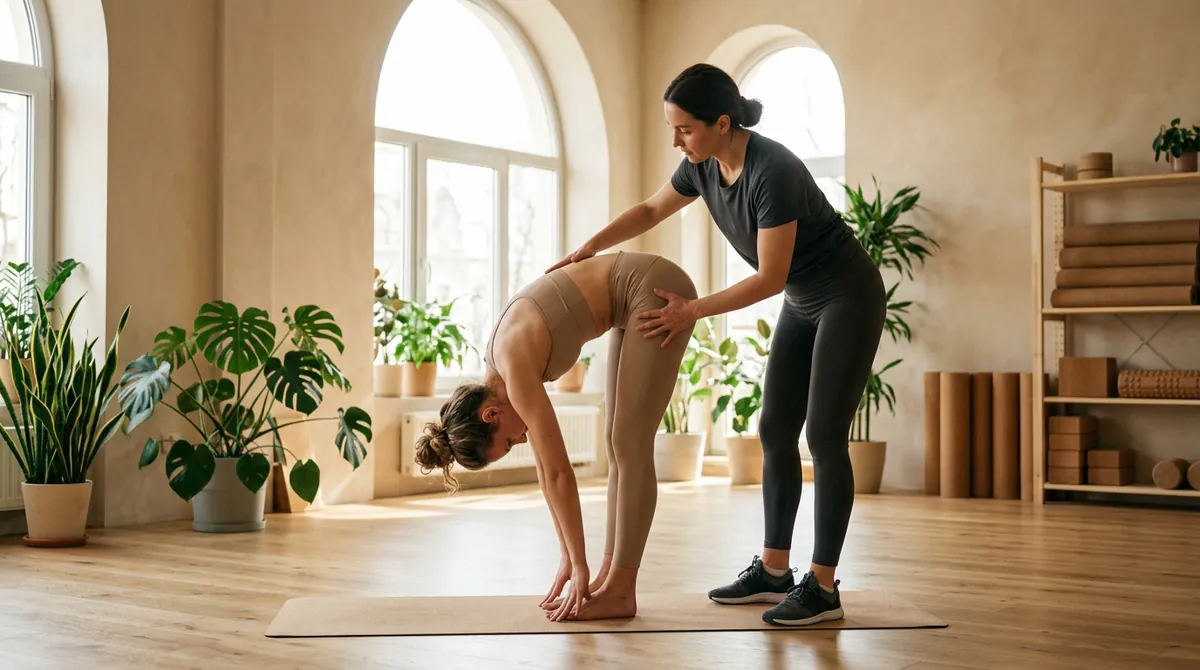
Stretching classes with a real coach get most people further than follow-along videos, for one plain reason: someone can see you from the side. You've been doing YouTube routines for six months, your forward fold hasn't moved, and your lower back grumbles afterwards. Sound familiar? It's usually something small, like a hip drifting open or a knee bending when you're not looking. You can't feel that from the inside. A coach spots it in a minute.
Mirrors only show you the front. Most stretching mistakes happen at the side and the back, where you have no view at all.
Here are common mistakes a coach spots from the side:
If you have back pain, an injury, you're pregnant or you've recently given birth, see your doctor first, then tell your coach what they said.
On your own, you do what already feels good. Same three poses, nice playlist, and a month later you're exactly where you started. Progress sits in the awkward stuff: weak hamstrings, glutes that won't hold your pelvis, muscles that need to switch on before they can lengthen.
A good coach puts things in order. Warm up, build strength at the range you already have, then go for length. The TOPSTRETCHING method works this way: a step-by-step system from zero to the splits that combines stretching, strength, posture and breathing, with roots in rhythmic gymnastics, ballet and Pilates.
Then there's measuring, which almost nobody does alone. We track range in numbers. Say, how many centimetres are left between your hips and the floor in the splits. Measure every few weeks and you'll see movement even when the mirror looks the same. Timelines differ: they depend on your starting point, how regularly you train and your joint structure. That's normal. If the splits are your goal, our beginner's guide to the splits shows the steps.
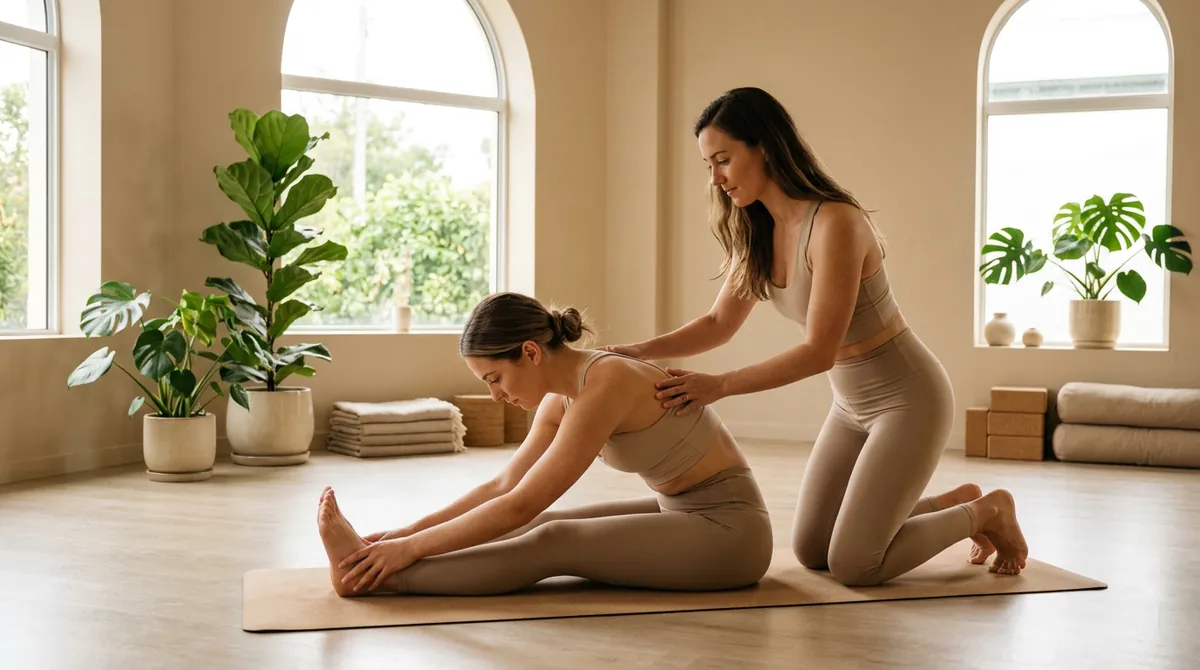
Assisted stretching means a coach uses their hands to guide you. They might hold your leg at the right angle, show you where your hip should drop, or ease you a little deeper on an exhale. Your muscles can let go more easily when someone else is supporting the position.
It only works if you talk. Agree on a scale before you start: 10 is your limit, and you work around 6 or 7. If you're silently gritting your teeth, tell them. A good coach wants to hear it and will back off without any fuss.
Ask before you're touched, too. In a decent class, a coach checks first, and you can always say you'd rather have the correction in words.
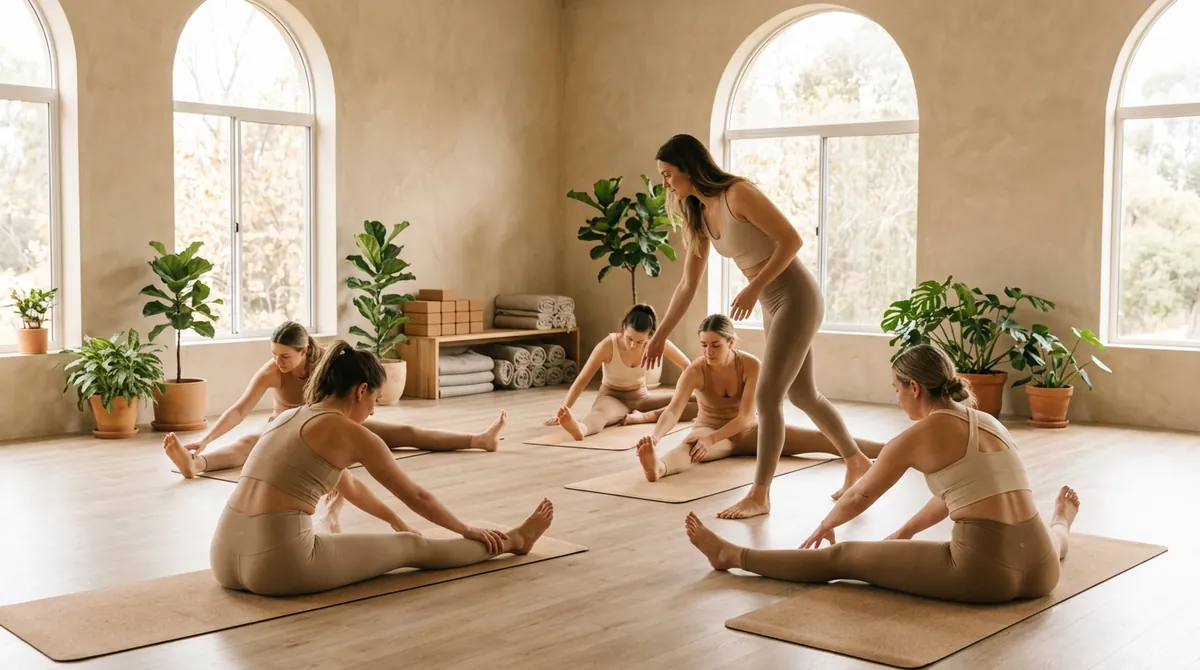
Group classes suit most people. The class is on your calendar, someone expects you, and skipping feels a bit awkward. At 7pm after a long day, that does more than willpower ever will. Hard poses are easier to hold when the woman next to you is breathing through the same thing.
Plenty of women come for the splits and stay for the people. We wrote about that in the studio as an environment.
One-to-one sessions make sense when:
Ask the studio what formats they run, and how big the groups get. You want a coach who has time to walk over to you, and a teacher demonstrating from the front mat can't do that.
Home stretching is worth keeping. Ten minutes after work builds the habit, and it costs you nothing. The catch is that a video can't see you. If your hip drifts open, you'll practise that hip for months.
Classes give you what a screen can't: corrections, a next step and someone counting your progress. So use both. Learn the technique in class, then repeat a couple of poses at home.
Frequency matters here. Going less than once a week usually just holds your range where it is, especially if you're starting the splits from zero.
Typing "stretching class near me" gets you a list. Here's how to narrow it down before you pay for a pack of classes:
There's more detail in how to choose a stretching studio. And if you've never been to one, read what a stretching class is like first. You can also see how classes run at our studios.
Before your first class, write your goal in one line: "get my splits", "stop slouching", "feel less stiff". Tell your coach. Mention old injuries too, even the ones that seem like nothing.
During class, ask questions. "Where should I feel this?" is the best question a beginner can ask. If you feel it somewhere else, say so right then.
Take a baseline on day one: your forward fold and your distance from the floor in the splits. Put the numbers in your phone.
Expect some soreness early on. A walk or a light stretch the next day helps. If the pain is sharp or sticks around for more than a few days, get it checked.
Between classes, ask your coach for the two stretches that matter most for you, and do just those for ten minutes on your off days. Most people do well with 2-3 classes a week plus those short home sessions.
Retest after five or six weeks and compare.
TOPSTRETCHING® is an international brand of stretching and mobility studios, founded in 2014 and built around women. Many of our coaches are masters of sport and candidates for master of sport in rhythmic gymnastics, and they all train to one standard across the network.
Right now you'll find our stretching studios in Bali and Zurich. The brand also runs AEROSTRETCHING®, Body Ballet, Barre and Pilates, so open the page for Bali or Zurich and see what's on there. Live somewhere else? The checklist above works for any studio, so take it along to a trial class near you.
They're sessions where a coach leads you through a structured program, watches your technique and corrects you with words or hands. It can be a group or one-to-one. Either way, someone is watching your body from the outside.
Yes. The TOPSTRETCHING method runs step by step from zero to the splits. You build flexibility in class, so you don't need it to start.
It's stretching where a coach physically supports or guides your position. You tell them how intense it feels, and they stay within what you agreed.
Most people do well with 2-3 classes a week plus short home sessions. Your coach can adjust that for your goal and recovery.
See your doctor first and find out the cause. If they clear you, tell your coach before class.
It varies. Your starting point, how regularly you train and your joint structure all play a part, so nobody can honestly give you an exact date.
Studios in Bali and Zurich: one method, coaches from professional sport and a trial class.
Find a studio →