
Pilates at home for beginners: what you need, six basic moves, wall Pilates options and a simple 4-week plan you can follow on a mat in your living room.
2 November 2026
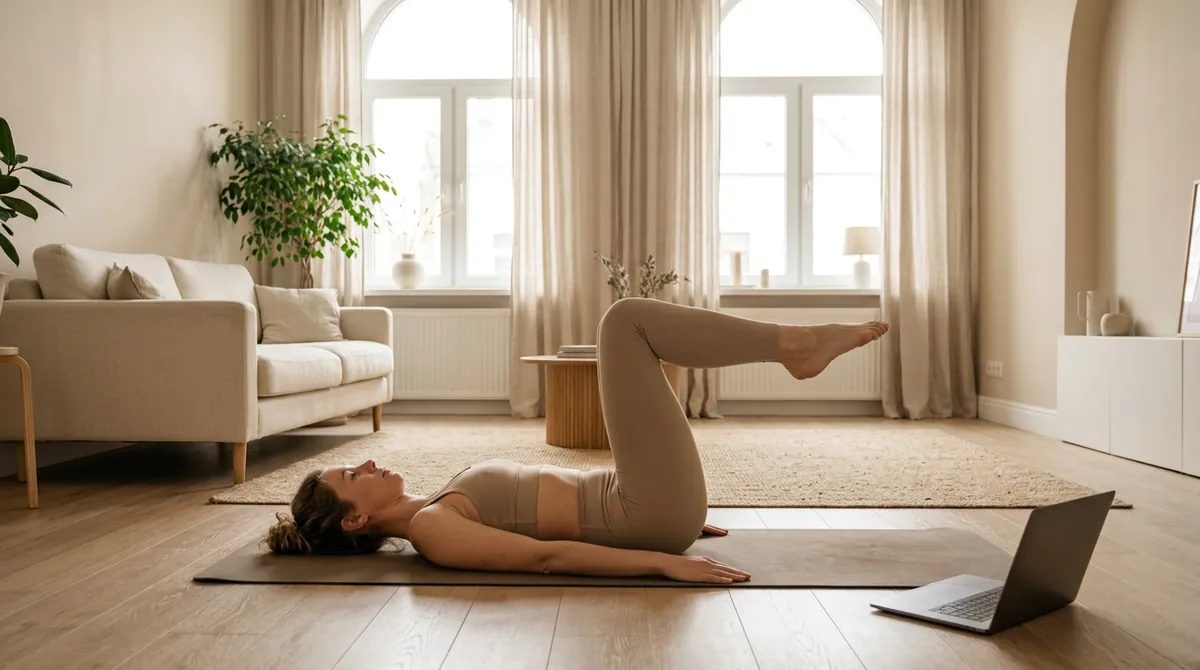
Pilates at home for beginners looks too easy to count as exercise. You lie on a mat, lift one foot a few inches and breathe. Five minutes later your stomach is shaking and you start to respect the whole thing. You can begin with a mat and 15 minutes. Below you'll find the setup, six moves to learn, how to use a wall and a four-week plan that goes easy on your lower back.
Pilates is a system of slow, controlled exercises for the muscles that hold you up: your deep abs, back, glutes and the small muscles around your pelvis. Joseph Pilates developed it in the early 20th century. You move through small ranges, in time with your breath, and you care more about how a rep feels than how many you do.
People often lump it in with stretching, but the two do different jobs. Stretching gives you range. Pilates teaches your muscles to control that range. That's why it sits alongside rhythmic gymnastics and ballet in the roots of the TOPSTRETCHING® method. If you're curious about the other half, here's what a stretching class is like.
So what do you notice first? Probably not abs. Most beginners feel it at the desk: sitting tall takes less effort, and your back is less tired by evening. If posture is your main worry, pair this with a short daily posture routine.
You barely need any equipment:
Before the first move, spend two minutes learning two basics.
Neutral pelvis. Lie on your back with knees bent and feet on the floor. There should be a small gap under your lower back, about enough to slide a flat hand through. Nearly everything starts from here. You don't need to press your back into the mat.
Breathing. Breathe in through your nose and let your ribs widen. Breathe out through your mouth and gently draw your lower belly in, the way you would to zip up tight jeans. Save the effort of each move for the exhale.
This short series hits your core, glutes and back, with a little work for your shoulders. Do 6 to 10 reps of each, three counts up and three counts down.
Finish with one minute in child's pose: knees wide, hips to heels, arms forward.
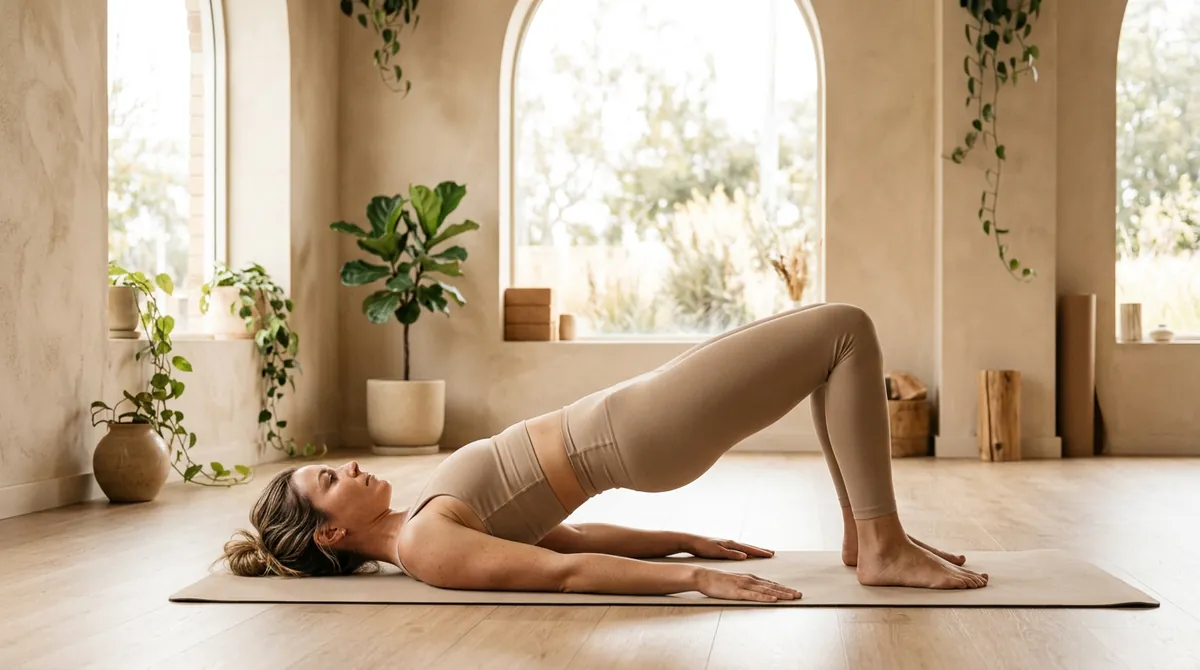
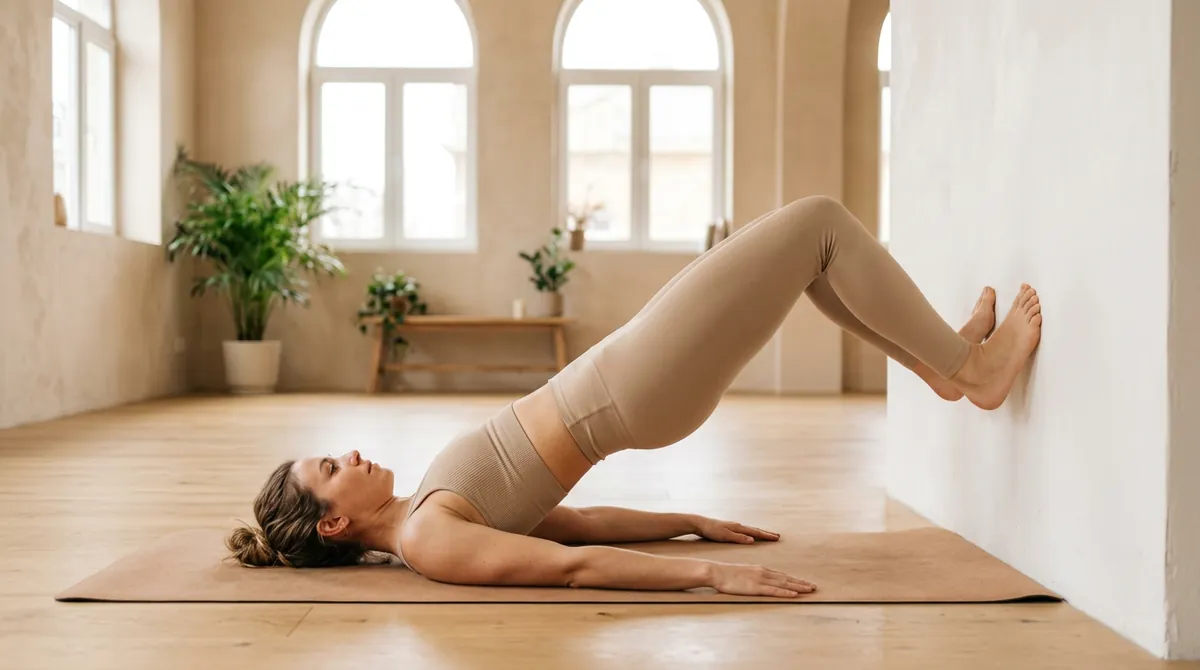
A wall tells you right away when your hips have shifted, and it does the job of equipment you don't own.
You'll see plenty of 28-day wall Pilates challenges online. Some are fine, but many move fast and skip the basics. Learn the six moves first and the wall will make more sense.
Three short sessions beat one heroic hour on Sunday.
Sore the next day? That's normal. Go for a walk and pick it up the day after. Missed a session? Carry on from where you stopped and don't try to make it up.
Ready to move on? Your last two reps should look as clean as your first two, and your breathing should stay steady. If they don't, repeat the week.
Got back pain, a disc problem or osteoporosis? Pregnant or recently had a baby? Talk to your doctor first and start only once they've cleared you. Pilates isn't a treatment, and some moves need changing in these cases. These guides on stretching for back pain and stretching after childbirth can help you with the first steps.
The hard part of working out alone is that nobody tells you your hips have drifted. Nobody tells you what comes next, either, once these six moves feel easy.
That's why Anna Kanyuk, a Master of Sport in rhythmic gymnastics and co-founder of TOPSTRETCHING®, is preparing online courses. FULL BODY is the one for beginners. The TOPSTRETCHING® method works step by step, so you won't have to guess what comes next. The courses open soon: leave your email on the courses page and we'll tell you first. Until then, have a look at our online training formats.
Yes, if your health allows it. All you need is a mat and 15 minutes. Start with neutral pelvis, breathing and three or four simple moves, then add more as they get easier.
Start with three 15-minute sessions a week and build up to four sessions of 20 to 25 minutes by the end of the first month. Your body responds better to regular short sessions than to one long one.
Yes. The wall helps you check your alignment and gives you support. It works best once you know the basics, such as neutral pelvis and breathing.
Pilates alone doesn't burn a lot of energy. It builds strength and works best alongside good food habits and daily walking.
Most people feel a difference within a few weeks, usually in how they sit and stand. Visible changes depend on your starting point, food and how regularly you practice.
Check with your doctor first. Some moves need changing or leaving out, so it's best to get a plan chosen for you.
Stretching, FULL BODY, facebuilding, TOP MAMA from anywhere in the world. Leave your email and be the first to get access.
Get notified →