
Exercises for posture you can do at home in 15 minutes a day: a simple routine for rounded shoulders, a 4-week plan and the mistakes that keep you stuck.
28 October 2026
Exercises for posture work when you do them a little, every day: fifteen minutes in the morning or after work does more than an hour once a week. Trainers see it in the studio all the time: someone walks in with shoulders up by her ears and her head pushed forward, and a couple of months later she stands differently. All she did was simple stuff on the mat, regularly.
Below is a daily routine you can do at home with no equipment. You'll also find what actually pulls your posture out of shape, a 4-week plan, and the mistakes that keep people stuck.
Posture is how your body stands when you're not thinking about it. Willpower holds it for a few minutes, and most of the day you're thinking about anything but your back.
The usual suspects are boring and everyday:
Rounded shoulders build up over years, so they leave gradually too. Your body does respond to regular practice faster than most people expect.
If your lower back bothers you too, read our guide to stretching for back pain. It covers the muscles that pull on the lower back.
Here's a quick test to start with. Stand with your back to a wall, heels about 5 cm away, glutes and shoulder blades touching it. Can the back of your head reach the wall without tipping your chin up? If not, your head has drifted forward, and that's where to begin. Check your lower back too: if your whole hand, or even a fist, slides behind it easily, the arch is too deep. Repeat the test in a month and compare.
Have a herniated disc, scoliosis, or a neck or shoulder injury? See a doctor first. Posture exercises don't replace treatment, and with a diagnosis it's best to build your routine with a specialist.
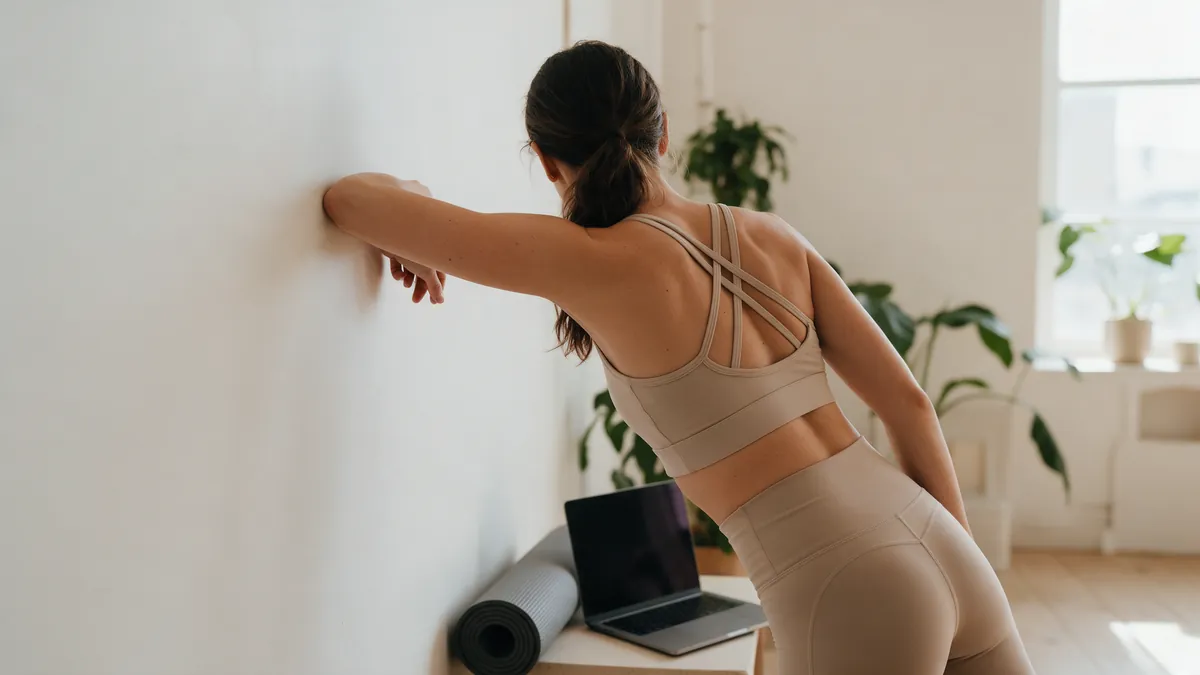
Do these in order. The whole routine takes about 15 minutes.
The order matters. First you open what's tight in front (chest and neck), then strengthen the upper back, and finally switch on the core that holds the new position.
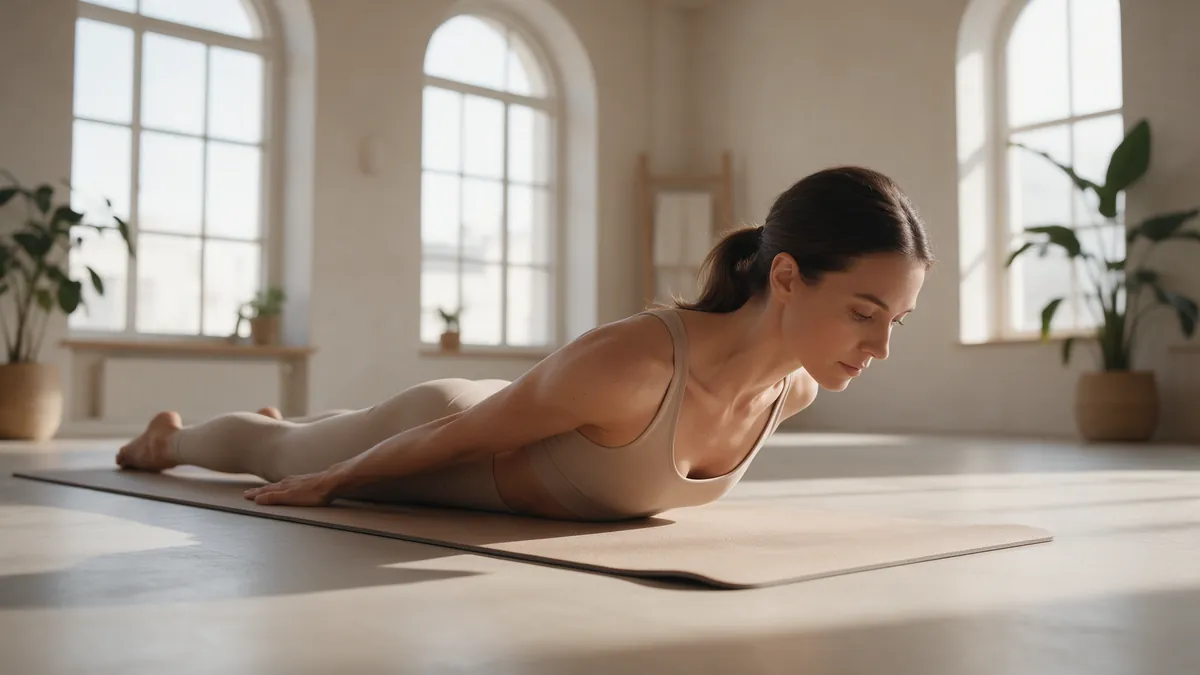
What will you notice first? Usually how you feel. Posture catches up later. Less heaviness in your neck by evening. Easier to take a full breath. The change in the mirror shows up once your body learns the new position and stops slumping back into the old one by evening.
Here's the most common story. Someone finds five posture exercises online, does them for a week, then forgets. Usually it's because she doesn't know what comes next, or why.
In the TOPSTRETCHING method, stretching always comes together with strength, posture and breathing. The method grew out of rhythmic gymnastics, ballet and Pilates, and progress is measured in numbers, not by eye. That fits posture well: without strength a chest stretch lasts an hour, and without measuring you can't tell whether anything changed.
You can take the same approach home. Take the short quiz and the app will build a personal plan from Anna Kanyuk's courses. Anna is a master of sport in rhythmic gymnastics and the brand's co-founder. In the quiz you tell it about yourself and your goal, so standing taller and fixing rounded shoulders can be the focus of your plan.
Why does that help with posture? Posture changes over weeks of regular practice, and most people drop off in week two. When a plan tells you what to do today and what's next, there's no guessing: you just show up on the mat. If you prefer group marathons with curators, see our online page.
Many people feel a difference in 2-3 weeks of daily practice, and a visible change in photos usually takes 1-3 months. It depends on how much you sit and how regularly you train. If you want a week-by-week plan built around you, take the quiz in the app.
The ones that open your chest and strengthen your upper back: the wall chest stretch, wall angels, the prone back raise and chin tucks. Add a plank for your core.
Yes. A gentle 10-15 minute routine is fine daily. If your muscles are very sore the next day, cut back on reps.
Yes, for everyday rounded shoulders from sitting, regular exercises help your shoulders settle back. If you have scoliosis or another diagnosis, see a doctor first.
A corrector reminds you to sit up, but it won't strengthen your muscles for you. Exercises build what holds your posture without it.
Answer 6 questions and the app builds a 4-week plan from Anna's courses: stretching, FULL BODY, facebuilding, TOP MAMA.
Get my plan →