
Studios Online Franchise About Blog
Expert Tips

Full Body Stretching Routine: 20 Minutes, Head to Toe

A 20-minute full body stretching routine, head to toe: 12 stretches with timings, a 4-week plan to make it daily, and the mistakes that slow beginners down.
Full Body Stretching Routine: 20 Minutes, Head to Toe

9 November 2026

A full body stretching routine doesn't need an hour and a fancy studio. Twenty minutes on a mat, head to toe, and you stand up feeling taller and looser. Below is the exact routine we'd give a friend who sits all day and wants to move better, plus how to turn it into a habit that sticks.

WHAT A FULL BODY STRETCHING ROUTINE ACTUALLY IS

A full body stretching routine is a set of stretches that works every major area in one go: neck, shoulders, spine, hips, legs and calves. You move from top to bottom, so nothing gets skipped and nothing gets overloaded.

Top to bottom is also easy to remember. After a week you won't need a list on the wall: neck, shoulders, back, hips, legs.

This routine is for:

  • Beginners who can't touch their toes yet
  • People who sit at a desk most of the day
  • Anyone who trains (running, gym, pilates) and skips stretching because "there's no time"

If you train hard, you also want a short cool-down right after the session. We covered that in stretching after a workout. This routine is a separate thing: your own 20 minutes, on any day, even with no workout at all.

BEFORE YOU START: TWO MINUTES OF WARM-UP

Cold muscles don't like to stretch. Two minutes of easy movement makes every stretch after it feel better and go deeper.

  • March on the spot for 30 seconds, swinging your arms
  • Roll your shoulders back 10 times, then forward 10 times
  • Circle your hips slowly, 5 times each way
  • Do 10 easy half squats

You want to feel warm, not tired. If you're slightly out of breath, you did too much.

A few rules for everything that follows:

  • Stretch to a pull, never to pain. On a scale of 1 to 10, aim for a 6.
  • Breathe out as you go deeper. Breathe in and hold still.
  • No bouncing. Hold the position and let the muscle relax into it.

THE 20-MINUTE ROUTINE, HEAD TO TOE

Set a timer for each stretch. Where it says "each side", split the time in half.
  1. Neck tilt (1 min). Sit tall, drop your right ear toward your right shoulder. Rest your right hand lightly on your head, no pulling. Switch sides.
  2. Chest opener (1 min). Clasp your hands behind your back, straighten your arms and lift them a little. Squeeze your shoulder blades together. Great for anyone hunched over a laptop.
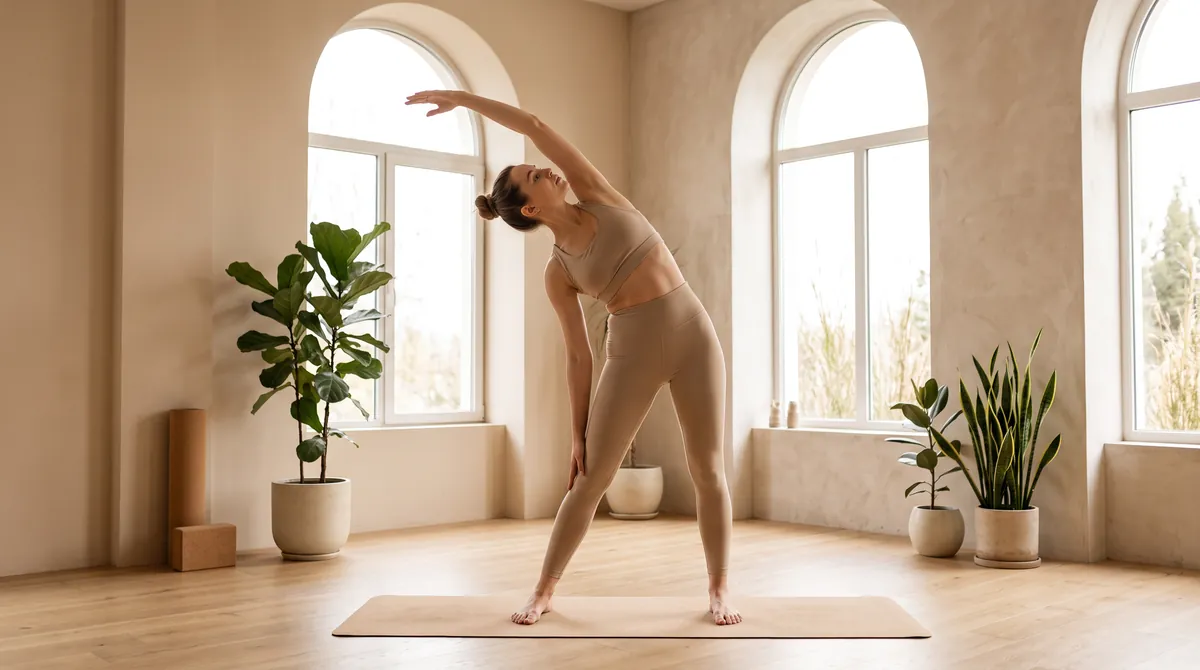
  3. Standing side bend (1 min, each side). Feet hip-width apart, reach one arm up and over. Keep both hips facing forward, don't lean back.
  4. Cat-cow (1.5 min). On hands and knees, round your back up as you breathe out, then let your belly drop and lift your chest as you breathe in. Slow, about 4 seconds each way.
  5. Thread the needle (1.5 min, each side). From hands and knees, slide one arm under your body along the floor and rest your shoulder and ear down. This one opens the upper back between the shoulder blades.
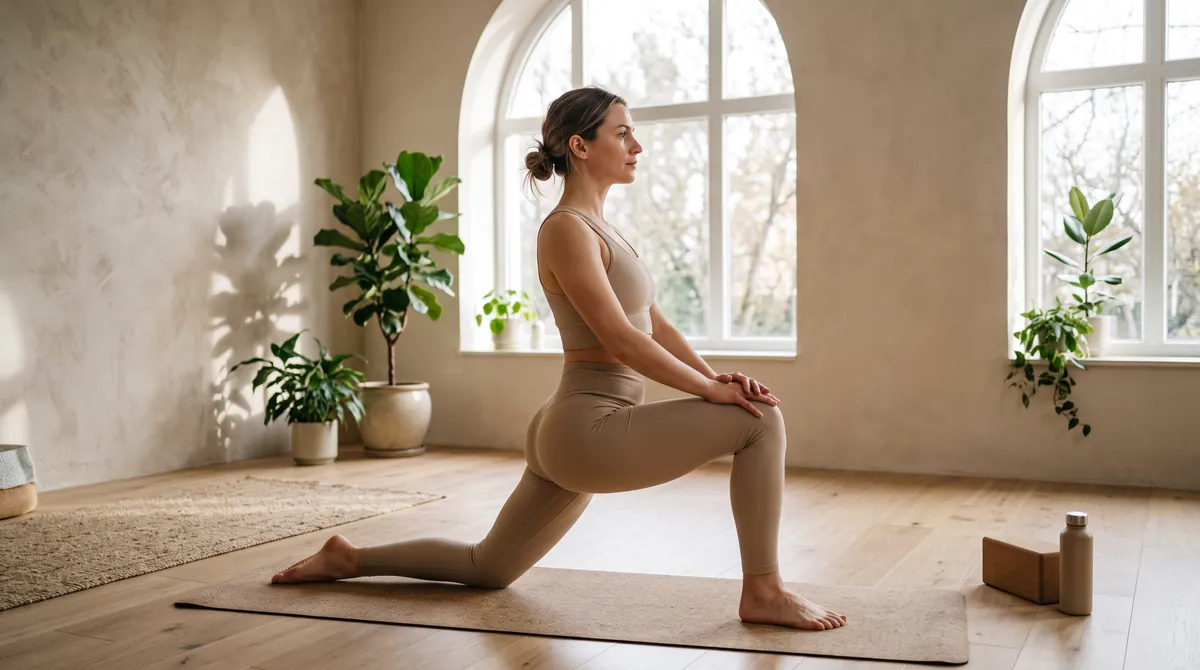
  6. Low lunge (2 min, each side). Step one foot forward, put the back knee down on a folded towel. Tuck your tailbone and shift your hips forward until you feel the front of the back hip open up. This is the stretch desk workers need most.
Low lunge: the back knee is down, hips move forward, the front of the hip opens
  1. Half split (2 min, each side). From the lunge, shift your hips back and straighten the front leg. Toes up, back flat. Hands on blocks or books if the floor is far away. You'll feel the back of the thigh.
  2. Figure-four (2 min, each side). Lie on your back, cross your right ankle over your left knee, then pull your left thigh toward your chest. Deep glute stretch, gentle on the lower back.
  3. Butterfly (1.5 min). Sit up, soles of the feet together, knees out. Hold your ankles and lean forward from the hips with a long back. Inner thighs.
  4. Seated forward fold (1.5 min). Legs straight in front of you, knees can bend a little. Reach for your shins or feet. Think chest to thighs, not nose to knees.
  5. Down dog calf pedal (1 min). Hands and feet on the floor, hips up. Bend one knee, press the other heel down, then switch. Calves and ankles get a turn too.
  6. Lying twist (1.5 min, each side). On your back, drop both knees to one side, arms out wide. Look the other way if your neck allows it.

Finish with 30 seconds lying flat, eyes closed, slow breathing. That's 20 minutes.

HOW TO TURN IT INTO A DAILY STRETCHING ROUTINE

Most people quit stretching the same way: they go too hard on day one, feel no change after a week, and drop it.

Here's a simple plan for the first month:

  • Week 1: 3 times a week, the full 20 minutes. Write down how far you reach in the forward fold (fingers to knees, shins, ankles).
  • Week 2: 4 times a week. Same routine, same timer.
  • Week 3: 5 times a week. Add 30 seconds to the stretches that feel tightest.
  • Week 4: check the forward fold again and compare.

Write the numbers down. In the TOPSTRETCHING method we track range of motion in numbers, not "it feels better, I think". Even a simple note like "fingers reached mid-shin" shows you the change on the days you're sure nothing is happening.
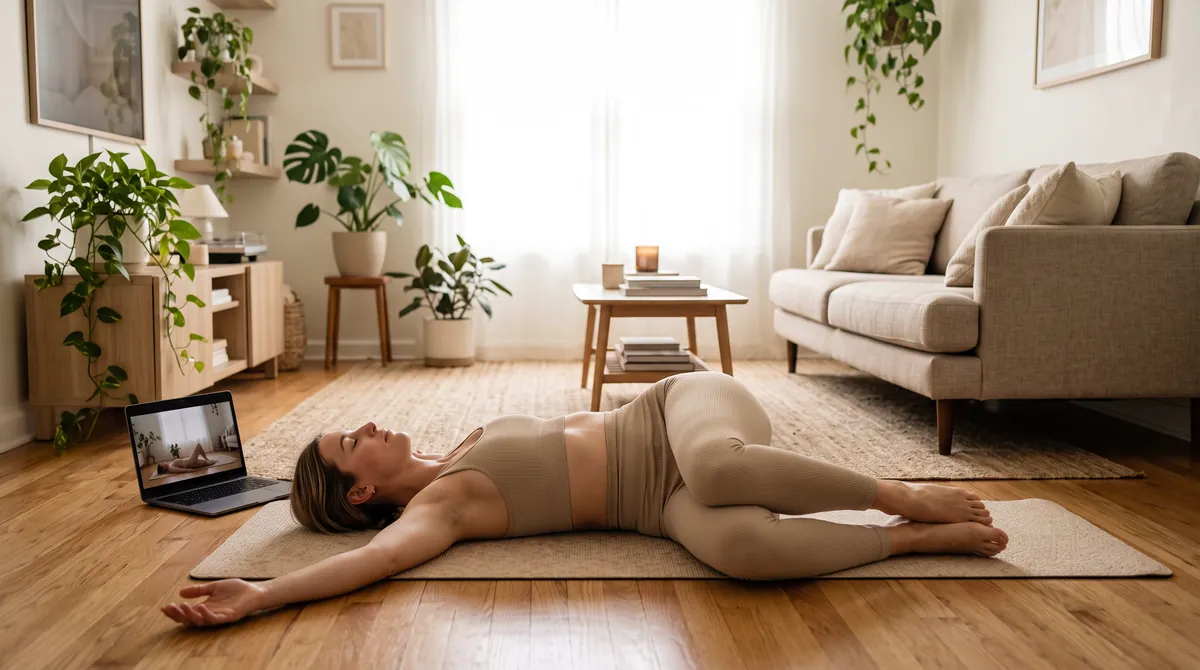
Stretching at home: a mat, a quiet corner and 20 minutes are enough

A few habits that help:

  • Stretch at the same time every day. Evening works well for most people because the body is already warm.
  • Keep the mat out. If you have to dig it out of a closet, you'll skip it.
  • Have a short version. On a bad day, do only the lunge, the figure-four and the twist. Six minutes still counts.

Want more structure than a list? Our online formats include marathons that run 3 to 6 weeks with curators who check in on you. If your goal is posture, pair this routine with exercises for posture, and if you dream about the splits, read how to do the splits once you're comfortable here.

MISTAKES THAT SLOW YOU DOWN

  • Holding your breath. If you can't breathe calmly, you're too deep. Back off a little.
  • Rounding your back to reach further. In the forward fold and half split, a long back with less reach does more than a hunched back with more reach.
  • Stretching only what's already flexible. Most of us love the butterfly and skip the lunge. Do the hard ones first.
  • Going for pain. Sharp pain, tingling or numbness means stop. If you have an injury, back pain that doesn't go away or you're pregnant, talk to your doctor before starting.
  • Expecting splits in a month. Flexibility grows over weeks and months. Some people see a change in two weeks, some in six.

WHEN YOU WANT SOMEONE TO GUIDE YOU

Doing a routine from an article works. But at some point most people want a coach's eye: is my back straight, am I tucking my pelvis right, why does my left side lag?

That's why we're preparing online courses by Anna Kanyuk, the founder of TOPSTRETCHING® and a master of sport in rhythmic gymnastics. One of them, FULL BODY, is built exactly for beginners who want a full body stretching routine with clear progression and a coach explaining every detail. The courses open soon. Leave your email on the courses page, and we'll tell you first when they launch.

Until then, roll out the mat tonight and do your 20 minutes.

FAQ

How long should a full body stretching routine take?

For most people 15-20 minutes is enough: about 2 minutes of warm-up, then 1-2 minutes per stretch for neck, shoulders, back, hips and legs.

Is it OK to do a full body stretch every day?

Yes, gentle stretching to a mild pull is fine daily. Start with 3-4 times a week and add days as your body gets used to it.

Should I stretch in the morning or in the evening?

Both work. In the evening your muscles are warmer, so stretches go deeper. In the morning keep it softer and do the warm-up first.

How fast will I get more flexible?

With regular practice most people notice a difference in 2-4 weeks, for example reaching further in a forward fold. Bigger goals like the splits take months.

Can beginners do this stretching routine?

Yes. Every stretch has an easy version: bend your knees, use books or blocks under your hands, and stop at a gentle pull.

Online courses with Anna Kanyuk are coming soon

Stretching, FULL BODY, facebuilding, TOP MAMA from anywhere in the world. Leave your email and be the first to get access.

Get notified →